Connect with us

Graduate Women International

Empowering women & girls through lifelong education

Play Icon Lyrics Icon
A long row of national flags flying on flagpoles outside a city building

General Assemblies


This page is part of the Members’ Corner. Open the Members’ Corner to continue.

The GWI General Assembly is held every three years. It is the governing body of GWI, and elects GWI’s Board of Officers and Committee Conveners and members.

35th Triennial General Assembly and Conference


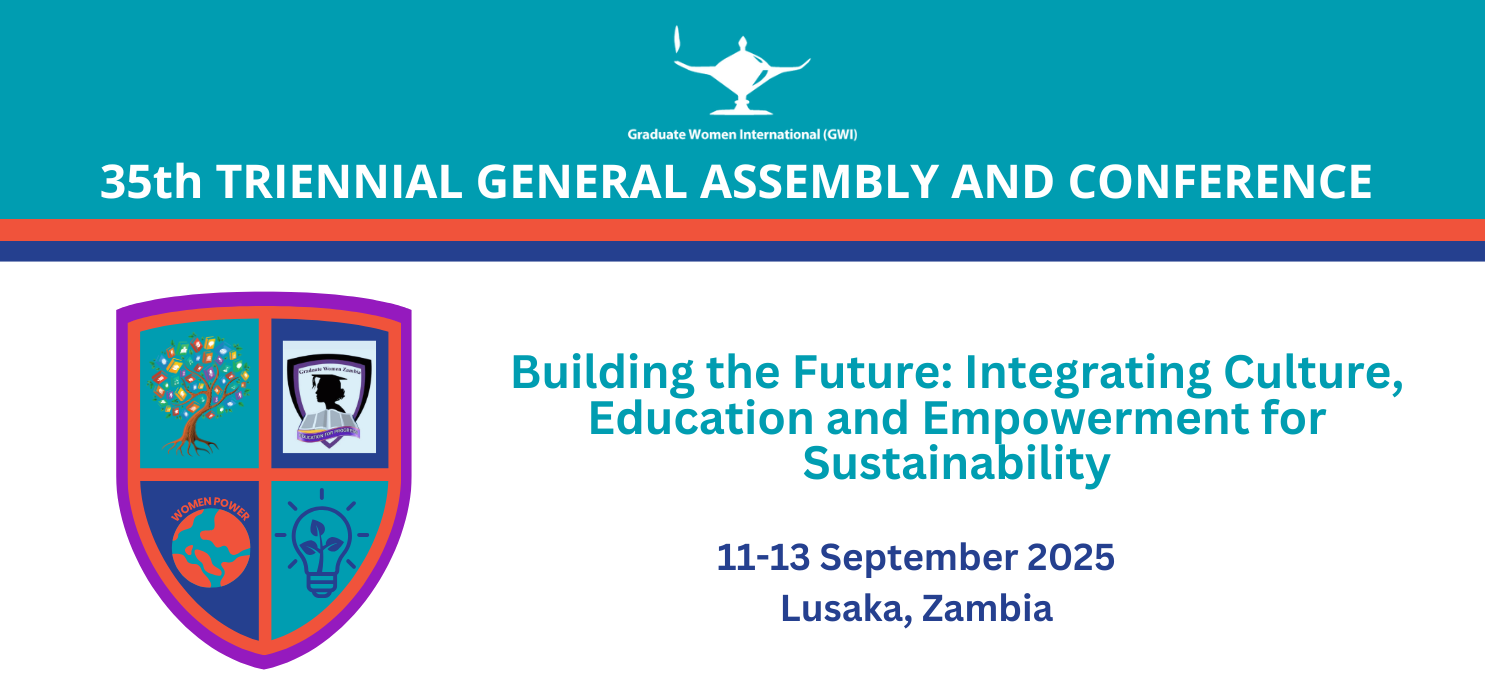
Banner for the GWI 35th Triennial General Assembly and Conference, theme Building the Future: Integrating Culture, Education and Empowerment for Sustainability, 11-13 September 2025, Lusaka, Zambia

REGISTER HERE

REGISTER HERE

The Graduate Women International (GWI) 35th Triennial General Assembly and Conference will take place from 11–13 September 2025 at the Mulungushi International Conference Centre in Lusaka, Zambia. This milestone event will convene GWI members and advocates from around the world to engage in critical dialogue on the future of education, women’s empowerment, and sustainability.

The priority theme is: Building the Future: Integrating Culture, Education, and Empowerment for Sustainability. With a focus on strengthening education systems through the lens of integrated cultural education relevance, the public conference will explore key global issues through five interrelated sub-themes:

  1. Education and empowerment for women in diverse contexts: Pathways to a sustainable future.
  2. What is a future context in which education, culture, gender, and the economy will operate?
  3. Gender-based cultural issues and barriers in education in relation to gender equity.
  4. How relationships, including intergenerational and community connections, enable growth and sustainability.
  5. Technology, AI, and Innovation: Relevance to Empowering Women for the Future.

These discussions will contribute to shaping GWI policies, strategies, and collaborations for the 2026–2028 Triennial, reinforcing GWI’s international commitment to equitable access to quality education for women and girls of all ages and demographics.

The registration fee for both the General Assembly and Conference is 350 Swiss francs. This fee provides access to all sessions, keynote addresses, related conference materials, workshops, seminars, networking breaks, and more. Early bird registration is open until 31 August 2025. After the early bird period, the regular registration fee will be 450 Swiss francs. Other registration categories are also available, including options for young members, guests, and attendance at the Zambian-themed Welcome Reception.

The conference will feature a distinguished roster of speakers, including international education leaders, policymakers, gender equity specialists, innovators in technology and AI, and grassroots advocates. These experts will bring diverse perspectives to the programme, offering participants practical insights and research-based strategies for advancing education, empowerment, and sustainability across global contexts.

In addition to the rich conference programme, participants will have the opportunity to experience Zambia’s cultural and natural heritage through a series of specially organized tours. These tours will offer unique insights into the country’s diverse traditions, historical landmarks, and stunning landscapes, enriching the overall conference experience. Pre-Conference and Post-Conference tours to be organized are (additional details and registration for tours will be published shortly).

Local tours planned by the Zambian Association of University Women (see the Local Tour page for additional information.)

The 2026-2028 Board of Officers and Committee candidates can be accessed HERE.

Circular 1/2025: Call for Policy Amendments

Circular 2/2025: 35th Triennial General Assembly (GA) Draft Agenda

Circular 3/2025: GWI Constitution Article VI section 9.1: Board Eligibility

Circular 4/2025: Call for Nominations for Graduate Women International Board of Officers and Standing Committees

Circular 5/2025: Call for Proposals for Workshops to be held at the GWI 35th Triennial Conference

Circular 6/2025: Call for Proposals for Interdisciplinary Seminar Papers to be held at the GWI 35th Triennial Conference

Circular 7/2025: Call for Amendments to the GWI Constitution for the GWI 35th Triennial

Circular 8a/2025: Final Proposed Amendments to the GWI Constitution

Circular 9/2025: Policy Resolutions Amendments

Circular 10/2025: Call for 35th Triennial General Assembly Voting Delegate Credentials

Circular 11/2025: 35th Triennial Reports – National Federations and Associations (NFA)

The 36th triennial conference program can be accessed HERE. 

Workshop and seminar abstracts can be accessed HERE.

Policy Resolutions passed by the 35th triennial General Assembly can be found HERE.

Access the GA Book HERE.

NFA 2023-2025 Triennial Reports can be accessed HERE.

Board and Committee 2023-2025 reports can be accessed HERE.

GWI offers every three years, on the occasion of its triennium, a fellowships programme that makes it possible for women graduates to complete exciting research in many important fields. For the 2025 round of fellowships, 80 qualified applications were received. The Fellowship Committee has completed reviewing all applications and will announce the 2025 fellowship winners by the end of May 2025.

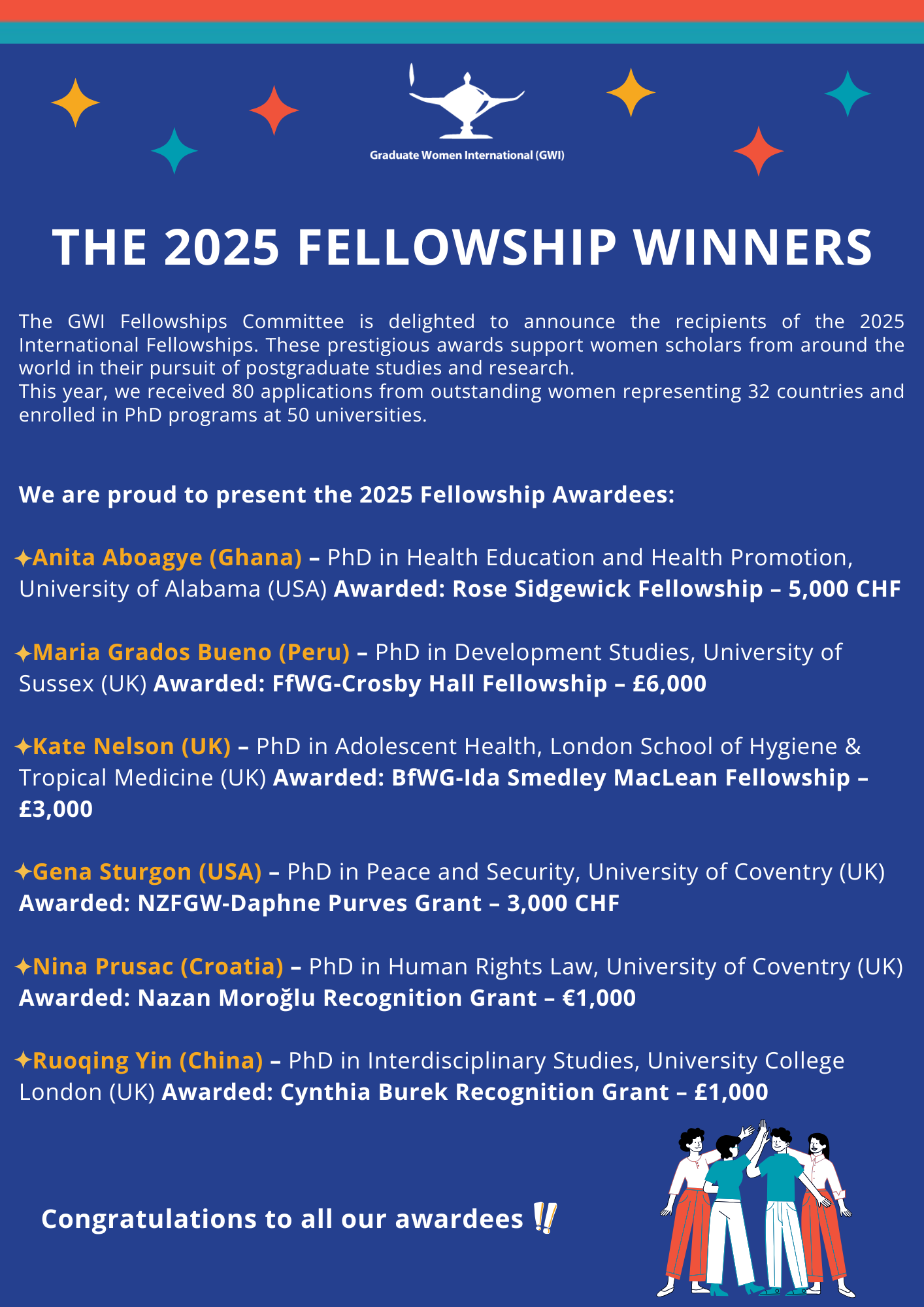
Flyer announcing the six recipients of the GWI 2025 International Fellowships and grants

Access the 35th Triennial General Assembly Draft Agenda HERE.

34th Triennial General Assembly and Conference


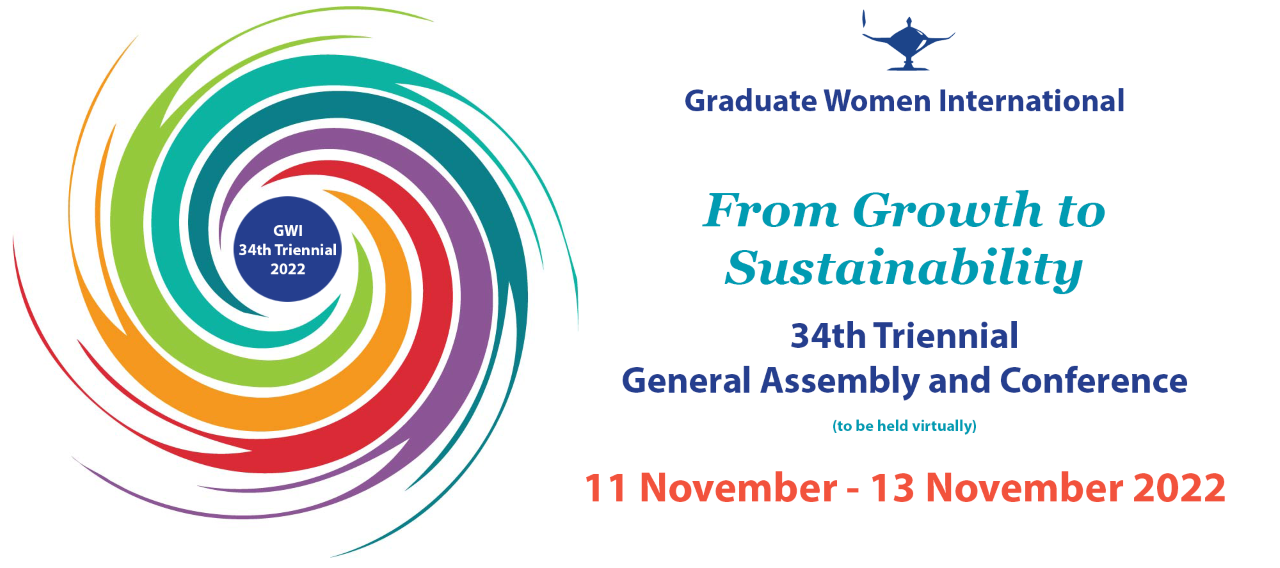
Banner for the GWI 34th Triennial General Assembly and Conference, From Growth to Sustainability, held virtually 11-13 November 2022The UN Sustainable Development Goals colour wheel beside the icon for Goal 4, Quality Education

Welcome to the GWI 34th triennial webpage.  We are excited about the General Assembly and Conference coming up in a few months!  We invite you to follow the link below to register for the From Growth to Sustainability virtual General Assembly and Conference.  Registration is only 60 Swiss francs.

Register here today! 34th Triennial General Assembly and Conference

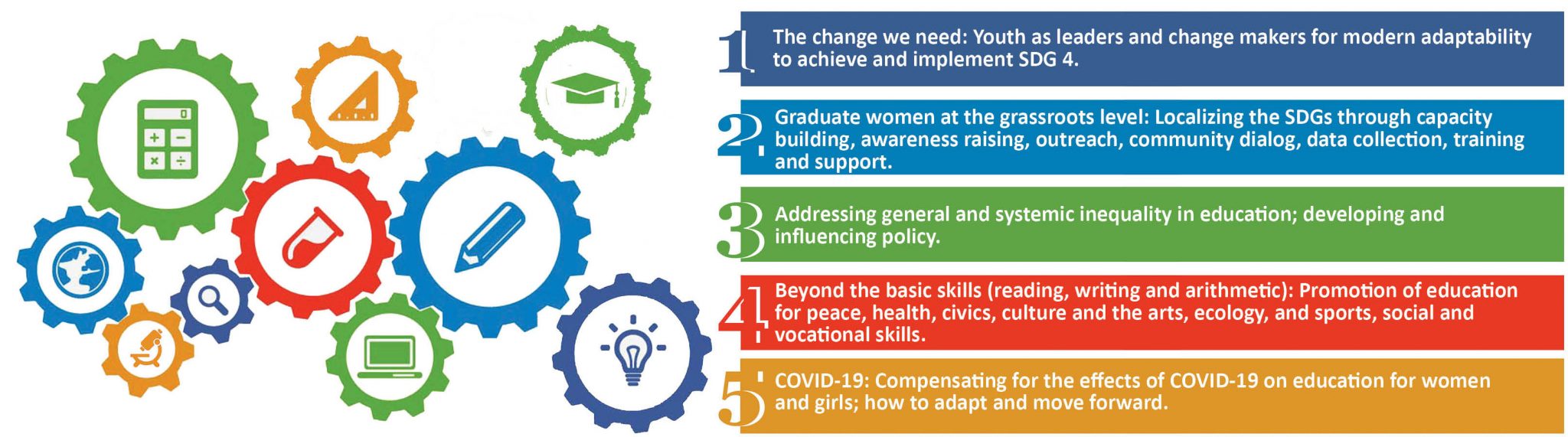
Subthemes for the 34th Triennial General Assembly and Conference are shown in the graphic below.  Workshops, seminars and panel discussions will centre around these five themes that relate to the Sustainable Development Goals, particularly SDG 4.

Graphic listing the five sub-themes of the GWI 34th Triennial Conference

Circular 21-2022 Proposed Constitutional Amendments

Circular 20/2022: 34th Triennial 10 Policy Resolution Final Texts

Circular 19/2022: Board of Officers and Committee Candidates

2023-2025 Candidates for Positions on the GWI Board of Officers 2022-2025

2022-2025 Candidate profiles for Committee Conveners and Members 2022-2025

Circular 18/2022: 34th Triennial Rules of Procedure, Agenda and Conference Schedule

Circular 16/2022: Proposed GWI Constitutional Amendments

Circular 15/2022: 34th Triennial Early Bird Registration Extended Until 31 October

Circular 14/2022: Policy Resolution Amendments: Deadline to submit amended text 10 October 2022

Circular 13/2022: Call for Voting Delegate Credentials – deadline 30 September 

Voting Delegate Credentials e-form can be accessed here.

Circular 13/2022- DEADLINE REMINDER

Circular 12-1/2022: 34th Triennial Reports: GWI Board of Officers – deadline 30 September

Circular 12-2/2022: 34th Triennial Reports: Committee Convenor, United Nations Representatives and Executive Director-deadline 30 September

Circular 11/2022 – 34th Triennial Reports: National Federations and Associations for the 34th Triennial General Assembly  – deadline 30 September

Circular 11/2022 NFA Reports Form

Circular 11/2022- DEADLINE REMINDER

Circular 10/2022 – Announcement of 34th Triennial Nomination Committee Members

Circular 10/2022 – Nominations Committee Members Profiles

Circular 9/2022 – 34th General Assembly Draft Agenda

Circular 8/2022 -proposed Constitutional Resolutions

Circular 8 2022 Proposed Constitutional Resolutions Submission Form

Circular 7/2022 – International Resolution 3: The Rate of Annual Dues Payable to GWI by NFAs

Circular 6/2022 V3- 2nd Call for Nominations for GWI Board of Officers and Standing Committees

Circular 6/2022 – Call for Nominations for GWI Board of Officers and Standing Committees

Circular 6/2022 supporting documentation:

Executive Board Descriptions

Committee Terms of Reference

Circular 5/2022- GWI Constitution Article VI section 9.1 Deadline Postponed 

Circular 4/ 2022 – Call for Proposals for Interdisciplinary Seminars to be held at the GWI 34th Triennial General Assembly and Conference to be held virtually 11-13 November 2022 

Circular 3/ 2022 – Call for Proposals for Workshops to be held at the GWI 34th Triennial General Assembly and Conference to be held virtually 11-13 November 2022  

Circular 2/ 2022 – DEADLINE EXTENSION: 22 May Circular 2/2022 – Call for GWI NFA Voting Delegate Credentials Statements for the GWI Electronic Vote 

Circular 2/2022 – Call for Voting Delegate Credentials Statements for the Electronic Vote to be held 1-3 June 2022 

Circular 1/2022 – Call for Policy Resolutions for the GWI 34th Triennial General Assembly  

Interactive workshops and seminars will be presented by GWI members by the Young Member Network, and members from Canada, El Salvador, India, Japan, Mexico, Netherlands, New Zealand, Nigeria, Paraguay, Sierra Leone, Spain, Turkey and the U.S.A.

The full workshop and seminar programme can be found HERE.

During the conference, one Zoom event item can be selected from each time frame session.

All sessions and panels will focus on the event theme and subthemes with the goal to Renew and Rebuild GWI and pivot towards a sharper focus on Sustainable Development Goal (SDG) 4, build working relationships with external stakeholders, and engage members in practical SDG 4 projects. Sessions complementing the subthemes will be offered by experts from GWI membership as well as distinguished and international speakers.

The virtual General Assembly and Conference is open to all GWI members worldwide. Registration is 60 Swiss francs. Register today by clicking HERE!   Non-members of GWI are invited to register for the Conference portion HERE.

The 10 GWI 34th triennial Policy Resolutions final text can be accessed HERE.

Resolution 1: Securing increased Domestic Funding for Education to include equal and safe access to Digital Learning

Resolution 2: Promoting and defending human rights of women in universities and other post-secondary forms of education

Resolution 3: Workplace Harassment

Resolution 4: To end under representation of women in media as a positive contribution to improve the status of all women in the world

Resolution 5: Violence Against Women in Politics

Resolution 6: Post Pandemic Recovery for Women and Girls

Resolution 7: Climate Change and Gender

Resolution 8: A Clean, Healthy and Sustainable Environment is a Human Right

Resolution 9: Climate Emergency – Declarations and Action Plans

Resolution 10: Single Use Plastics and Plastic Packaging

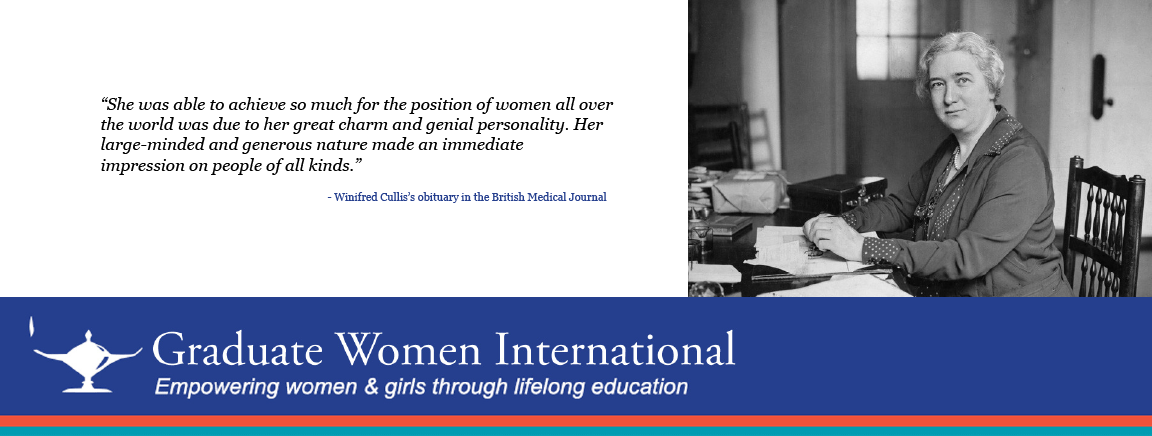
A quotation from Winifred Cullis's obituary in the British Medical Journal beside a photograph of her at her desk, above the Graduate Women International banner

GWI offers every three years, on the occasion of its triennium, a fellowships programme that makes it possible for women graduates to complete exciting research in many important fields. Click HERE for more details on the fellowships.

The 2022 award winners are:

The GWI 2022 Winifred Cullis Fellowship was awarded to Caitlin McMillan, Canadian, University of North Carolina at Chapel Hill, PhD title: Making space for the Displaced: Examining the Impact of Humanitarian practices on care and Wellbeing amongst Refugees in Cyprus.

Funds for Women Graduates- Crosby Hall Fellowship was awarded to Samantha Newby, American, University of Manchester, PhD title: The Design of a Textile-Based, Wearable, Thin-Film System for Harvesting and Storing Body Thermal Energy.

Ida Smedley Maclean International Fellowship British Federation of Women Graduates was awarded to Elisa Genovesi, Italian, Kings College London, PhD title: Development and pilot evaluation of a programme to help teachers support children with developmental disabilities in mainstream school settings in Ethiopia.

Daphne Purves Award – New Zealand was awarded to Isabela Dos Santos, Brazilian/Canadian, University of Toronto, PhD topic: An Oasis of Peace in the Heart of the Israeli-Palestinian Conflict: The Case of Wahat al-Salam/Neve Shalom.

Fay Weber Grant was awarded to Klara Mundilova, Czech, MIT, PhD title: Curved crease origami design from theory to practice.

Cynthia Burek Environmental Recognition Award was awarded to Hannah Fitchett, British, University of St. Andrews, PhD Title: The ‘nature’ of Climate Activism: an examination of Extinction Rebellion as a movement of conceptual and ethical reform in London and Madrid.

Nazan Moroglu Young Members Recognition Award was awarded to Shalini Nair, Indian, University of Sussex, PhD title: Exclusionary discourse of sexual violence in India.

GWI Recognition Award was awarded to Eliza Goodpasture, American, University of York, PhD title: Kindred Spirits: Friendship and Ambition Among Women Artists in England, 1870-1920.

GWI Recognition Award was awarded to Sarah Hiepler, American, University of Aberdeen, PhD title: Death’s place in museum practices, displays, and interpretation: an ethnography examining death in university museums in the UK.

GWI Recognition Award was awarded to Michele Pflug, American, University of Oregon, PhD title: ‘In pursuit of her Butterflies’: Madness, Violence, and Science in the English Countryside, 1650-1715”.

GWI Recognition Award was awarded to Hebatallah Tolba, Egyptian, University of East London, PhD title: A becoming: Materiality, affect and subjectivity in women’s religious rituals practice in Egypt.

GWI Recognition Award was awarded to Diana Volpe, Italian, University of Oxford, PhD title: Legitimacy, discourse, and power: Italy-Libya relations, and the case of the Mediterranean.

GWI Recognition Award was awarded to Yurung Yu, Chinese, Imperial College London, PhD topic: Measuring biodiversity impacts with more precision, less bias and more influence.

33rd Triennial Centenary Conference


Graduate Women International centenary logo for Peace through Education, 25-28 July 2019, Geneva, SwitzerlandTwo stacks of reports and ring binders

Circular 17/2019 Updated – Voting and Voting Delegates

Circular 17 /2019 – Voting Delegates

Circular 17/2019 Annex: Proxy Voting Form

Circular 17/2019 Annex: Voting Credentials Form

Circular 16/2019 – Proposed Amendments to Resolutions

Circular 15/2019 – Constitutional Resolution 1 – Australia Amendment

Circular 15/2019 – Constitutional Resolution 1 – Australia Amendment

Circular 14/2019 – Hegg Hoffet Sale Items 

Circular 12/2019 – 33rd General Assembly Agenda – Procedural Rules – Conference Programme of Work

Circular 12/2019 – Annex 1: 33rd General Assembly Agenda

Circular 12/2019 – Annex 2: Procedural Rules

Circular 12/2019 – Annex 3: Peace Through Education Centenary Conference Programme of Work

Circular 11/2019 – Conference Information, Policy Resolutions, Revised Internal Resolution 4 and proposed Constitutional Amendments

Circular 11/2019 – Conference Information, Policy Resolutions, Revised Internal Resolution 4 and proposed Constitutional Amendments

Circular 10/2019 – Board Internal Resolutions Corrected

Circular 10/2019 Board Internal Resolutions

Circular 10/2019 – Board Internal Resolutions (full resolutions)

Circular 9/2019 – NFA Credentials and Instructions 33rd triennial

Circular 9/2019 – NFA Credentials and Instructions 33rd triennial – Word Version

Circular 8/2019 – Board and Committee Nominees

Circular 8/2019 – Board and Committee Nominees 

Circular 7/2019 – Constitutional Amendments

Circular 7/2019 – Constitutional Amendments

Circular 6/2019 – Board and Committee Travel Grants

Circular 6/2019 – Reimbursement of Expenses – Board and Committees 

Circular 5/2019 – Call for Bids for the 2022 GWI Triennial Conference

 Annex 1 – 34th Triennial Conference Bid Information 

Annex 2 – GWI Triennial Conference Bid Form 

Circular 4/2019 – Policy Resolutions Extension

Circular 4/2019 Extension of Policy Resolutions Deadline

Resolutions Submissions Form

Young Member Workshop – “Connecting the Power of GWI Young Members”

Young Member Workshop Flyer 

Update from the President – Young Member Workshop, Registration Fee and Travel Subsidies

Circular 3/2019 – 33rd General Assembly Preliminary Agenda

Rules of Procedure for face-to-face meeting of the GWI General Assembly Draft Agenda of the 33rd GWI General Assembly

Circular 2/2019 – National Federation and Association 2019 Triennial General Assembly Reports

NFA 2019 Triennial General Assembly Form

Circular 1/2019 – Nominations Deadline Extension

Nomination Application Form

Board of Officers Job Descriptions

Committee Terms of Reference

Candidate Instruction Form

Bio Data Forms

Board of Officers

Education Committee

Finance Committee

Hegg Hoffet Committee

International Fellowship Committee

Project Development Committee

Membership Committee

Resolution Committee

Workshops

Theme 1: How can education advance the status of women and girls worldwide and work towards preventing conflicts, protect the most vulnerable populations and transform societies?

  • Building Peace through Education of Heart and Mind ( Canada) -Joy Hurst, Grace Hollett, Brenda Robertson and Godelieve De Koninck
  • Otherness and Belonging : Remaking Inclusive spaces for ALL Women ( New Zealand) – Sita Venkateswar, Shirley Gillett, Gretta Mills
  • Link between Education and Gender Equality – the eradication of violence against women (Israel) – Ora Sharon
  • How to keep women at the top! – Brigitte Mantilleri
  • Powerful Women are Happy Women (Turkey) – Yasemin Donmez, Berna Kir, Funda Savas Gun
  • Using the GWI Gender Equity Toolkit –Shirley Gillett, Ranjana Bannerjee, GWI Edcom
  • The Impact of Education on the Culture of Peace and Development in Africa (Senegal)- Marie Pierre Sarr
  • Women and the Peace Process in Sierra Leone – Linda Williams
  • A Peaceful Future through Women and Girls Education (USA) – Dr Johanna Sterbin, Dr Ingeborg Loetterle, Jacqueline Shahzade

Theme 2: How can curricula grow and change to support human rights and deconstruct patriarchal and other societal paradigms to bring about a culture of peace and non-violence?

  • Unravelling the patriarchy within women to enable more courageous decision-making & sustainable implementation of women’s initiative (India)  – Shruti Sonthalia
  • Successful Strategies in Learning and Teaching Mathematics while Supporting Human Rights (India) – Dr Rahael Jalan, Swati Bedekar, Nandini Sonthalia
  • Breathe Free : Say NO – Stop Abuse (India) – Dr Anagha Lavalekar, Anjali Railkar, Anita Gurja

Theme 3: What does it mean to live in a connected world, two-thirds of which are in conflict and how does this impact on our daily lives?

None

Theme 4: How can young professionals be empowered to understand and make connections between education, gender equality issues, culture change and environmental issues and what effects do these have on their careers, family lives and the planet?

  • Mentoring for Peace and Development (Fiji) – Maria Pastorizo-Sekiguchi, Sonia Khan, Elizabeth Fong

Theme 5: What can graduate women do to influence a global society, working at the intersection of education, peace, advocacy and action in local, national and global policies?

  • Academic women: Their Way to Equality, Parity in the Academic World (Britain) – Dr Gillian Hilton
  • The importance  of Accessibility of Networks and the Mission of GWI in a Crisis – Reiko Aoki,  Nobuko Akita, Yaeko Sumi, Takeko Takata
  • Hope for the Future (Turkey) – Dr Basak Ovacik, Rengin Turksoy, Yasemin Celik Yardimci
  • Taking Action to Implement GWI Resolutions on Peace – Kathleen Laurila, Amy Dowdle, Alice Dahle
  • Women at Peace in Business –Anoush De Boghossian
  • Teach Peace Project (Ghana) – Joyce Atta-Quartey,  Korklu Laryea, Irene Kafui Amponsah
  • Taking GWI Forward after the First 100 years.  Tools to attract young professional women (Israel) – Shiri Malca
  • Labor Rights of Graduated Professionals and their Future Peace of Mind (El Salvador) – Dr Ana Mirella Wollants Schoenenberg, Fabiola Wollants, Rosa Maria Mendoza de Serrano

Seminar Papers

Theme 1: How can education advance the status of women and girls worldwide and work towards preventing conflicts, protect the most vulnerable populations and transform societies?

  • Creating Agents of Peace through Non-Formal Education – Dr Meera Bondre
  • The Power of Immersive Education: Education and Peace in the 21st Century – Sana Vaidya
  • Investing in Women’s Education for Peaceful Societies in Developing Countries – Dr Rosa de Serrano
  • Educating Women & Girls – a Panacea for Preventing Conflicts/ Protecting Vulnerable Populations – Dr Adebayo Olufunke, Dr Comfort Onifade
  • Determining Educational Goals for Peaceful Coexistence (JAUW) – Chizuko Suzuki
  • Implementing Women ZONE  (UNESCO) for Peace, Nutrition, Education, and Matriarchal system’s values restoration – Rokhaya Daba Fall
  • Advancing the Status of Women through Education for Social Harmony (Hong Kong)- Dr Jackie Yan, Dr Anson Honghua Wang, Dr Janice Pan
  • Migration – Education – Integration? Challenges in educational work with refugees – Prof Shirley Randell
  • Peace through educating women for social, economic and political change in India – Abeda Inamdar
  • Schooling Interventions: Keep Girls from Dropping Out, and Help Women’s Re-entry – Suvarna Gokhale
  • Peace through Education – Perspectives of Gender and Girl’s Empowerment – Dr Remi Aduradola, Prof Comfort Onifade
  • Mary has a Little Goat.  A Holistic social and educational enterprise (Uganda) – Consolata Tumwesigye
  • Transitional challenges confronting heads of midwifery training colleges in the Western & Central regions of Ghana which affect human rights and sustainability – Dr Marie Bakah
  • Women, Girls and Technology Education – Magda Buhake Kaniki
  • The role of Cinema in Education and the Struggle against Sexist Stereotypes: an account of a Grenoble, France experience –Vianella Guyot
  • Improvement in HIV/Aids Knowledge – Integrated Intervention for Sustainable Development – Dr Nita Mawar

Theme 2: How can curricula grow and change to support human rights and deconstruct patriarchal and other societal paradigms to bring about a culture of peace and non-violence?

  • Peace and Education Curricula Incorporating Human Values (UNESCO) – Prof. Thanaa Ezz
  • Achieving Peace through Democratic Citizenship Education (Ghana) – Joyce Atta-Quartey, Irene Kafui Amponsah
  • Role of (Indian) Indigenous Economic Education for Peace and Sustainability – Dr Kalyani Bondre
  • Global Education – Teaching and Curriculum Development for Peace Education – Dr Marion Myhill
  • Curbing Violence against Women through Lifelong Learning (Nigeria) –Prof Comfort Onifade, Dr Remi Aduradola
  • The Paths of Education for Peace, Non-violence and Gender Equality in Higher Ed Institutions in Latin America – Dr Gloria Ramirez
  • Incorporating Peace Education in English as a Foreign Language (EFL) and Similar Curricula as a Means of Implementation – Sahar Gamal
  • Understanding the Implications of Female Genital Mutilation (FGM) on Women’s Sexuality through Women’s Education (Nigeria) – Prof Anthonia Uzuegbunam
  • Balancing the Institutional and Cultural Mindset of Patriarchy in Nigeria with Curriculum – Nneka Chiedozie-Ude

Theme 3: What does it mean to live in a connected world, two-thirds of which are in conflict and how does this impact on our daily lives?

None

Theme 4: How can young professionals be empowered to understand and make connections between education, gender equality issues, culture change and environmental issues and what effects do these have on their careers, family lives and the planet?

  • Understanding the Digital Gender Gap in Mexico – Nayana Guerrero-Ramirez
  • Global Problems Addressed with Local Solutions: A case of NGOs creating  Environmental Awareness – Dr. Nita Mawar
  • Empowering Youth to Internalise and Spread Gender Parity through Sexuality Education – Dr Anagha Lavalekar
  • Women Educators Empowering Change at Home for a Peaceful Society –Irene Kafui Vorsah Amponsah
  • Preparing Women for Leadership Positions in Education/ Mentoring Initiatives by substantive school heads (Ghana) – Dr Marie Bakah

Theme 5: What can graduate women do to influence a global society, working at the intersection of education, peace, advocacy and action in local, national and global policies?

  • Heard the Voice of Women? The Impact of Graduate Women (Turkey) – Dr Basak Ovacik
  • Experiences of Women in Leadership – a Dream or Nightmare? (Ghana) – Dorothy Addo-Mensah
  • Mobilization of Young Graduates for Social Activities and a Peace Hike: Communication Challenges/Solutions – Ieva De Sousa
  • Women’s Social Mobility by Education Attainment? (Mexico, South Africa and Vietnam) – Dr Lukasz Czarnecki
  • Marginalisation of Women and its Effect on Peace Restoration in S-E Nigeria – Prof Anthonia Uzuegbunam
  • Field Evidence of Non-violent Civilian Protection Methods is Used by Women Advocates to Transform Conflict – Kathleen Laurila
  • Bridgebuilding for Peace, Education & Advocacy: Creating a Winning Partnership – Florence Babalola-Smith
  • New Business Models for Social Impact : Entrepreneurship for 21st C. Intersection of leadership for Econ Empowerment and Global Advocacy – Shaila Rao Mistry
  • Unleashing the Potential of Women:  The Promise of Education for Peace (Lithuanian Antanina Gustaityte-Salciuviene) – Rima Binder
  • Involvement of Women Leaders within Higher Education (Ghana) – Gladys Edumadze
  • What can Graduate Women do to Mitigate Suffering in Disasters? – Kyoko Hirata
  • The Process of Commission on the Status of Women (CSW) in the quest for securing women’s rights – GWI Board / UN Representative

Posters

Theme 1: How can education advance the status of women and girls worldwide and work towards preventing conflicts, protect the most vulnerable populations and transform societies?

  • How the voices of youth calling for nuclear abolition can reach around the world (Case study, Nagasaki) – Chizuko Suzuki

Theme 2: How can curricula grow and change to support human rights and deconstruct patriarchal and other societal paradigms to bring about a culture of peace and non-violence?

None

Theme 3: What does it mean to live in a connected world, two-thirds of which are in conflict and how does this impact on our daily lives?

None

Theme 4: How can young professionals be empowered to understand and make connections between education, gender equality issues, culture change and environmental issues and what effects do these have on their careers, family lives and the planet?

None

Theme 5: What can graduate women do to influence a global society, working at the intersection of education, peace, advocacy and action in local, national and global policies?

  • Exploring strengths of Gender Statistics/Indicators. Principles of Design of Surveys – Dr Miranda Mortlock
  • Introducing new knowledge into Higher Education in Costa Rica –  value of graduate  women networks – Thais Ramirez Cordoba

Final Policy Resolutions

Constitutional Resolutions

The following Constitutional Resolutions were voted on at the GWI 33rd General Assembly in July 2019 in Geneva, Switzerland :

Internal Resolutions

The following Internal Resolutions were voted on at the GWI 33rd General Assembly in July 2019 in Geneva, Switzerland :